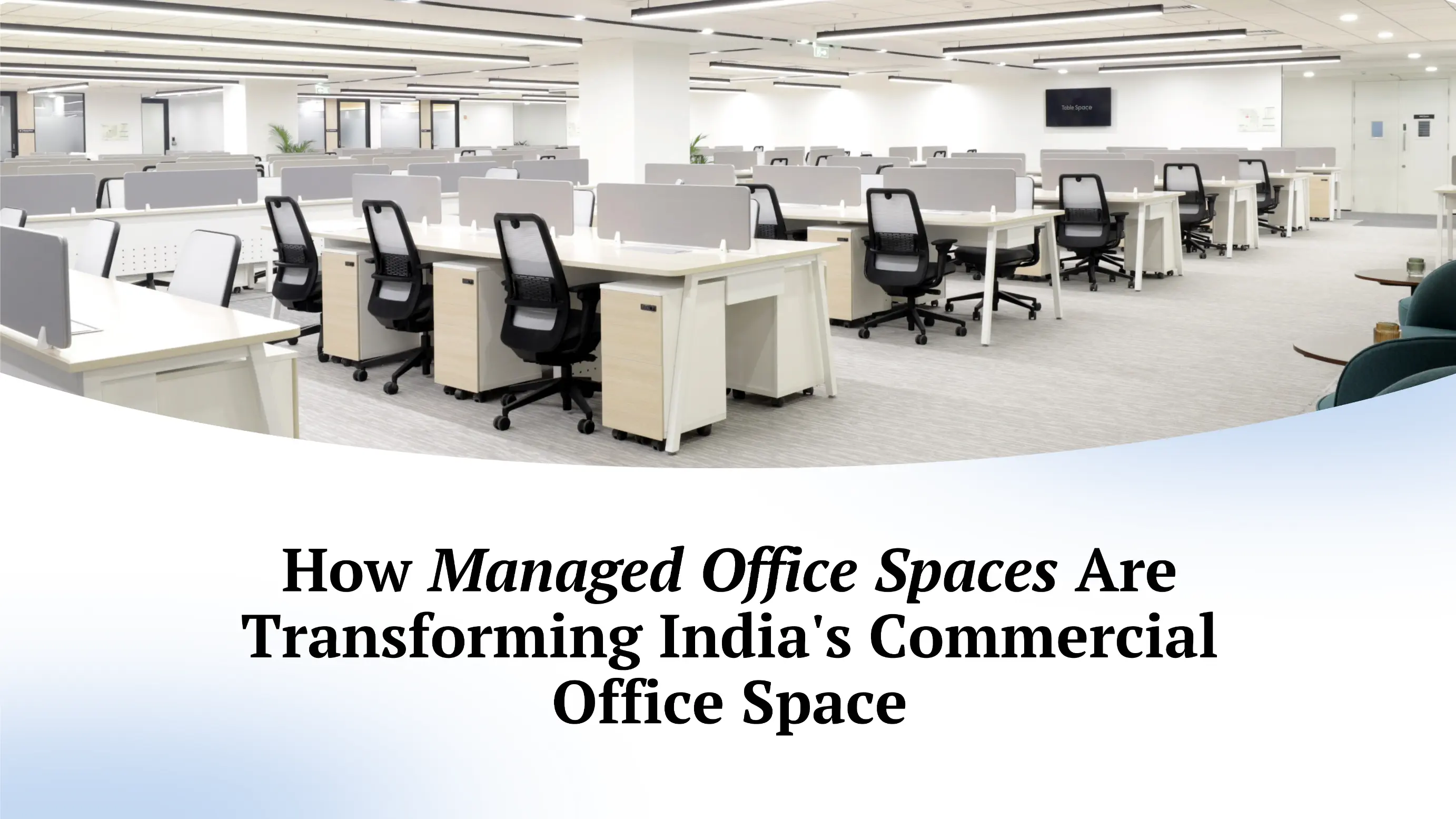
India's commercial office market has a new operating layer. It is called the managed office, and it is changing who can access Grade A workspace, on what terms, and at what speed.
India's commercial office market crossed 83.3 million sq ft of gross leasing in 2025, a record by any measure. Net absorption hit 57 million sq ft, the highest ever recorded. Vacancy dropped to a 5-year low of 15.2%. These are the numbers of a market undergoing genuine structural expansion, not a cyclical uptick in demand.
Within that expansion, the managed office model has moved from a niche product serving small teams to the default workspace structure for a significant share of Fortune 500 GCC operations in India. The shift has consequences that extend beyond the enterprises making individual workspace decisions. It is changing the economics of Grade A office supply, the relationship between landlords and occupiers, and the terms on which global enterprises access Indian cities.
Understanding what the managed office model has done to India's commercial office market requires understanding what was there before it.
What the Conventional Model Required
Before the managed office model matured, a Fortune 500 enterprise establishing a GCC in India faced a fixed set of requirements. A direct lease with a 5 to 9 year term and a security deposit of 6 to 12 months' rent. Fitout capital committed before occupancy. A setup timeline of 12 to 18 months. The internal capability to manage 7 to 10 vendor relationships across construction, facilities, IT, security, and compliance, or the budget to hire someone to do it.
This structure was viable for large enterprises with established India operations, dedicated real estate functions, and the capital to absorb multi-month setup costs before the operation generated output. For mid-sized global companies, first-time India entrants, and enterprises with headcount projections likely to change within 18 months of signing, it was frequently not an available option. The conventional model excluded a significant share of the global demand that India's talent market was capable of absorbing.
What the Managed Office Model Added
The managed office model did not replace the conventional lease. It created an alternative access point to Grade A workspace that eliminated the structural barriers the conventional model imposed.
Security deposits dropped from 6 to 12 months to 1 to 2 months. Fitout capital was eliminated, folded into a single monthly operating fee. Setup timelines compressed from 12 to 18 months to approximately 90 days. The internal real estate function was no longer required. Compliance infrastructure, previously arranged independently after handover, became a standard output of the design and build process.
The aggregate effect was the opening of Grade A commercial office space in India to a category of enterprise that the conventional model had effectively excluded. Mid-sized global companies, first-time India entrants, and compliance-driven organisations that needed their workspace infrastructure to be operational from day one of occupancy could now access institutional-quality workspace on terms that matched their operating requirements.
The Scale at Which This Has Happened
Table Space's portfolio tells the quantitative story. Founded in 2017, the company now operates 11.5 million sq ft across 8 cities, 80+ centres, and 425+ enterprise clients, with occupancy above 90% on a leasable area of approximately 10.2 million sq ft as of 31st March 2026. Annual revenue stands above USD 170 million. The client base spans Fortune 50 and Fortune 500 enterprises, 125 GCCs, and organisations across BFSI, technology, engineering, healthcare, pharma, consulting, and new-economy sectors.
In FY 2025-26 alone, Table Space delivered 3.2 million sq ft across 125+ enterprise projects, with 20+ projects of 50,000 sq ft and above. Year-on-year delivery growth of 45% pan-India. Mumbai delivery growth of 250 to 300%. Hyderabad delivery growth of approximately 200%. These are not the numbers of a niche product serving a specialist market. They are the numbers of a structural layer that has been added to India's commercial office market at scale.
"We founded Table Space in 2017 on a single thesis: the managed office would become the standard for enterprise workspace in India. 11.5 million sq. ft., 425+ clients, and 90%+ occupancy later, the market has settled the argument”
Karan Chopra, Chairman & Co-CEO
How It Is Changing the Market
The managed office model has changed India's commercial office market in 3 ways that are now structural rather than cyclical.
The first is the compression of the entry timeline. When a global enterprise can be occupying compliant, Grade A workspace in Bengaluru, Hyderabad, or Pune within 90 days of a decision, the interval between strategic intent and operational reality is 3 months, not 18. That compression changes how enterprises think about India expansion. It removes the 'we need to start planning 2 years out' constraint and makes India accessible on the timeline that business decisions actually operate on.
The second is the democratisation of institutional-quality workspace. Grade A office infrastructure in Bengaluru's ORR corridor or Hyderabad's HITEC City was previously accessible primarily to enterprises with the capital, the real estate function, and the setup runway to lease directly. The managed model has made that infrastructure accessible to a mid-sized company establishing its first 150-seat India presence on a 90-day timeline, under a contract structure that matches its capital position.
The third is the alignment of workspace structure with business flexibility. A conventional 7-year lease signed to a fixed headcount assumption is a liability for any enterprise whose India operation is still growing. The managed model, structured with contractual flexibility to scale seats up, scale down, or relocate within the provider's network, aligns the workspace contract with the business reality rather than a projection that was accurate on the day it was made and outdated 18 months later.
Where the Market Is Going
India's Grade A office stock is projected to surpass 1 billion sq ft by 2030. The flex workspace segment, which includes managed offices, has grown at a CAGR of 23 to 25% since 2020. Flex penetration has reached 12 to 16% in Bengaluru and Pune, with the national Grade A average at approximately 8 to 10%.
The enterprises building the India operations that will occupy that stock are making workspace decisions based on capital efficiency, compliance readiness, and contractual flexibility rather than on traditional lease terms. The managed office model has not disrupted India's commercial real estate market. It has added the operational layer that the market needed to serve the next generation of global enterprise demand at the speed and flexibility that demand requires.
Table Space was founded in 2017 on the thesis that the managed office model would become the standard for enterprise workspace in India. The portfolio today, 11.5 million sq ft, 425+ clients, 125 GCCs, occupancy above 90%, is the operating evidence that the thesis was right.
Frequently Asked Questions
What is a managed office space and how does it differ from a conventional lease?A managed office is a private, fully customised workspace built to the occupier's specifications and operated end-to-end by a single provider under one consolidated monthly fee. Unlike a conventional lease, the occupier does not manage the real estate lifecycle independently. Fitout capital is eliminated, security deposits are reduced to 1 to 2 months, and setup timelines compress to approximately 90 days from 12 to 18 months.
How has the managed office model changed access to Grade A office space in India?It removed the structural barriers the conventional lease model imposed: large upfront capital requirements, long setup timelines, and the need for an internal real estate function. Mid-sized global companies, first-time India entrants, and compliance-driven organisations can now access institutional-quality workspace on terms that match their operating requirements.
What is the current scale of managed office space in India?India's flexible workspace stock has reached 110 to 114 million sq ft, growing at a CAGR of 23 to 25% since 2020. Flex penetration is at 12 to 16% in leading markets such as Bengaluru and Pune. Table Space alone operates 11.5 million sq ft across 8 cities, with occupancy above 90% on a leasable area of approximately 10.2 million sq ft.
Why is the managed office model growing faster than the conventional lease model in India?Because it aligns workspace structure with how enterprises actually operate: with headcount trajectories that change, compliance requirements that are active from day one, and capital that is better deployed toward talent and operations than toward deposit and fitout. The 90-day delivery standard and the single-contract accountability structure remove the 2 constraints that most consistently slow enterprise expansion in India.